The answer in brief
Directors learn from influential films by looking past the finished image and reconstructing the decision behind it. Ask what problem the filmmaker faced, what resources were available, what risk was accepted, and why the chosen camera position preserved the consequence. Influence becomes useful when it improves your judgment, not when it gives you a look to copy.
Why is copying a beautiful shot not enough?
A finished shot hides the production pressure that created it. You see the framing, movement, light, performance, and cut. You do not automatically see the weather, location, schedule, equipment, personalities, mistakes, or one-time opportunities surrounding the camera.
That hidden layer is often where the most valuable lesson lives.
In the book, I describe how deeply John Frankenheimer's The Train influenced the way I think about producing films. What stayed with me was not a recipe for making every movie look like his. It was the relationship between physical production choices and the images that survived them.
The lesson was not to find a train. The lesson was to recognize what reality is offering, decide what matters, and cover the consequence.
What did the train-wheel shot teach me?
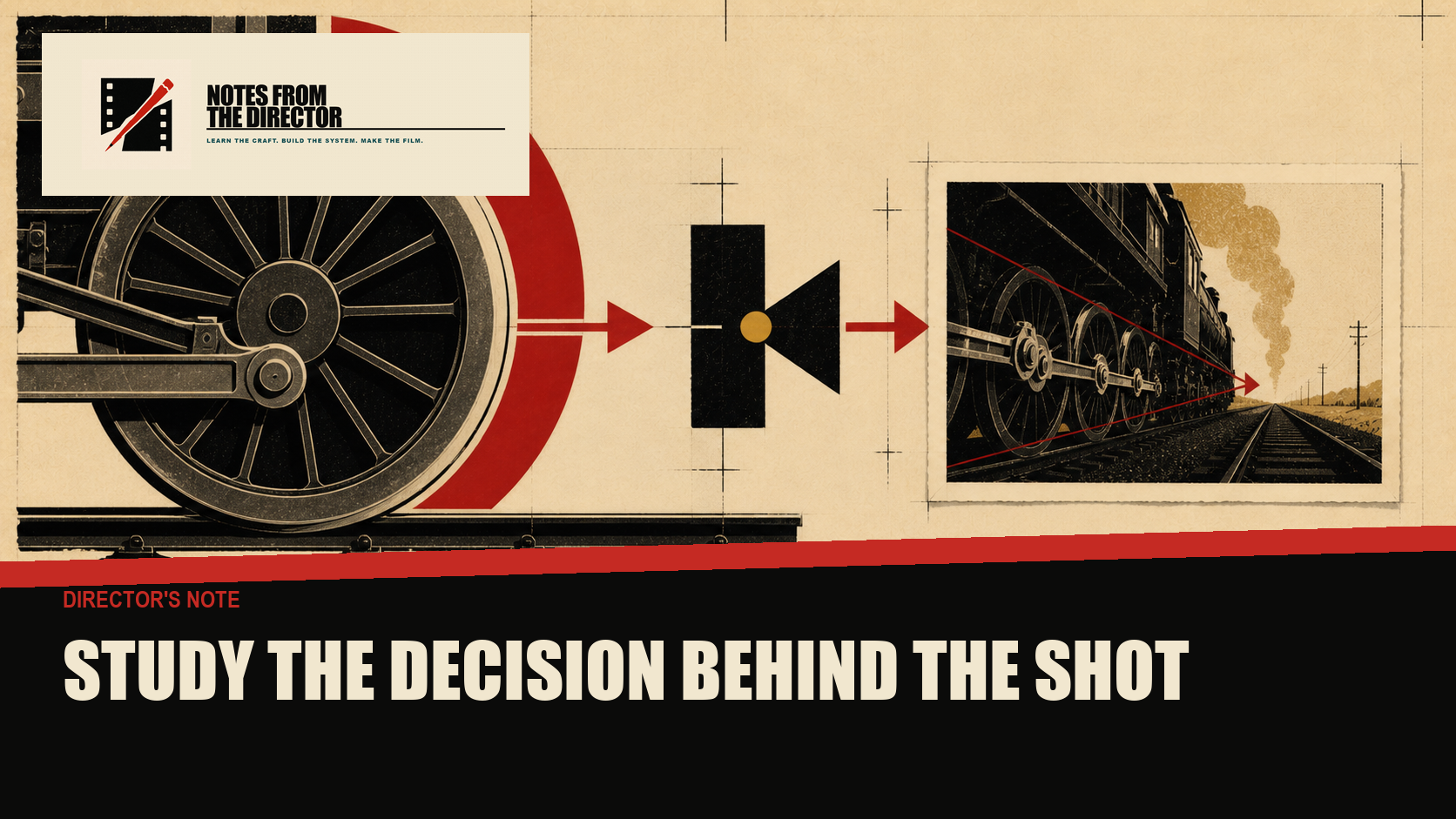
I recount a train crash staged with multiple cameras. The train came in faster than expected, and the crash destroyed all but one camera. The surviving image ended with the damaged train stopping near the lens while a wheel continued to turn.
That image mattered because the camera was present when an irreversible event happened. Nobody could reset the crash and ask for another take. Coverage was not decoration. It was protection against losing the event.
The production decision behind the shot involved risk, placement, physical reality, and the knowledge that only one attempt existed. The result carries a force that cannot be separated from those conditions.
When I study a scene like that, I do not stop at the composition. I ask what had to be true for the composition to exist.
Which questions reveal the decision behind a shot?
Use one scene, not an entire film. Choose a shot that keeps returning to your mind, then work through these questions:
- What story information changes during the shot?
- What emotion should the audience feel before and after it?
- What physical event or performance could not be easily repeated?
- Where is the camera, and what does that position protect?
- What production limitation may have shaped the choice?
- What would be lost if the shot were cleaner, safer, or more conventional?
- Which part is visual style, and which part is production judgment?
You may not know every historical answer. That is fine. The exercise is not an excuse to invent behind-the-scenes facts. It is a way to train your eye to connect the visible result to the decisions a director must make.
How do you turn influence into your own direction?
Once you identify the decision, remove the famous movie from the exercise.
Write down a problem in your own project that has the same shape. Maybe you have one chance to capture a practical effect. Maybe a location gives you only twenty minutes of usable light. Maybe a performer can reach an emotional moment only a few times. Maybe the action cannot be repeated without resetting an entire set.
Now decide what must be protected.
The answer might be an additional angle, a safer master, an earlier rehearsal, a camera placed for consequence instead of beauty, or a decision to let the event play without interruption. That is influence doing real work. You did not borrow an image. You borrowed a way of seeing the production problem.
What belongs on a shot-decision analysis card?
Create one card for the shot you are studying. Keep it short enough to use during preproduction.
- Story turn: What changes in the scene?
- Irreplaceable event: What cannot be recreated easily?
- Production pressure: What limitation shapes the day?
- Protected element: What must the audience see or feel?
- Camera decision: Where does the camera belong, and why?
- Coverage decision: What second view protects the edit?
- Accepted risk: What are you willing to lose to get the important image?
- Transfer: Where does the same decision appear in your film?
The card is complete when it ends with a decision for your production. A page of admiration is not yet directing.
When has film study become productive?
Study has done its job when it changes what you prepare, where you place the camera, what you protect, or what you are willing to simplify.
You do not need to become an expert on every filmmaker who influenced you. You need to become more alert to consequence. The image on the screen is the receipt. The decision is the department that produced it.
Watch the films you respect. Look harder at the moments that feel impossible to forget. Then bring one useful decision back to your own set.
Next production note
Study can sharpen judgment, but the identity of director begins only when that judgment is used on a real project.
Continue to: You Become a Director by Directing
Notes From the Director Learn the craft. Build the system. Make the film.
Source note
This article is adapted from No One Gives a F Until It's Done, PDF pages 28-29. The account of The Train and the train-crash coverage is presented as Wayne's interpretation of the production lesson in the manuscript. No additional historical claims have been added.