The answer in brief
Clear practical obligations before deep creative work by grouping predictable, unpleasant tasks into a protected weekly block. Pay bills, handle maintenance, answer required messages, and prepare what the week needs. The goal is not to earn creativity through suffering. It is to prevent known obligations from repeatedly breaking concentration later.
Why do ordinary obligations damage creative focus?
The task itself may be small. The open loop is not.
An unpaid bill, unwashed equipment case, unanswered scheduling message, or overdue errand can remain in the background while you write or edit. Part of your attention keeps checking whether the neglected task has become urgent.
Then it interrupts at the worst moment.
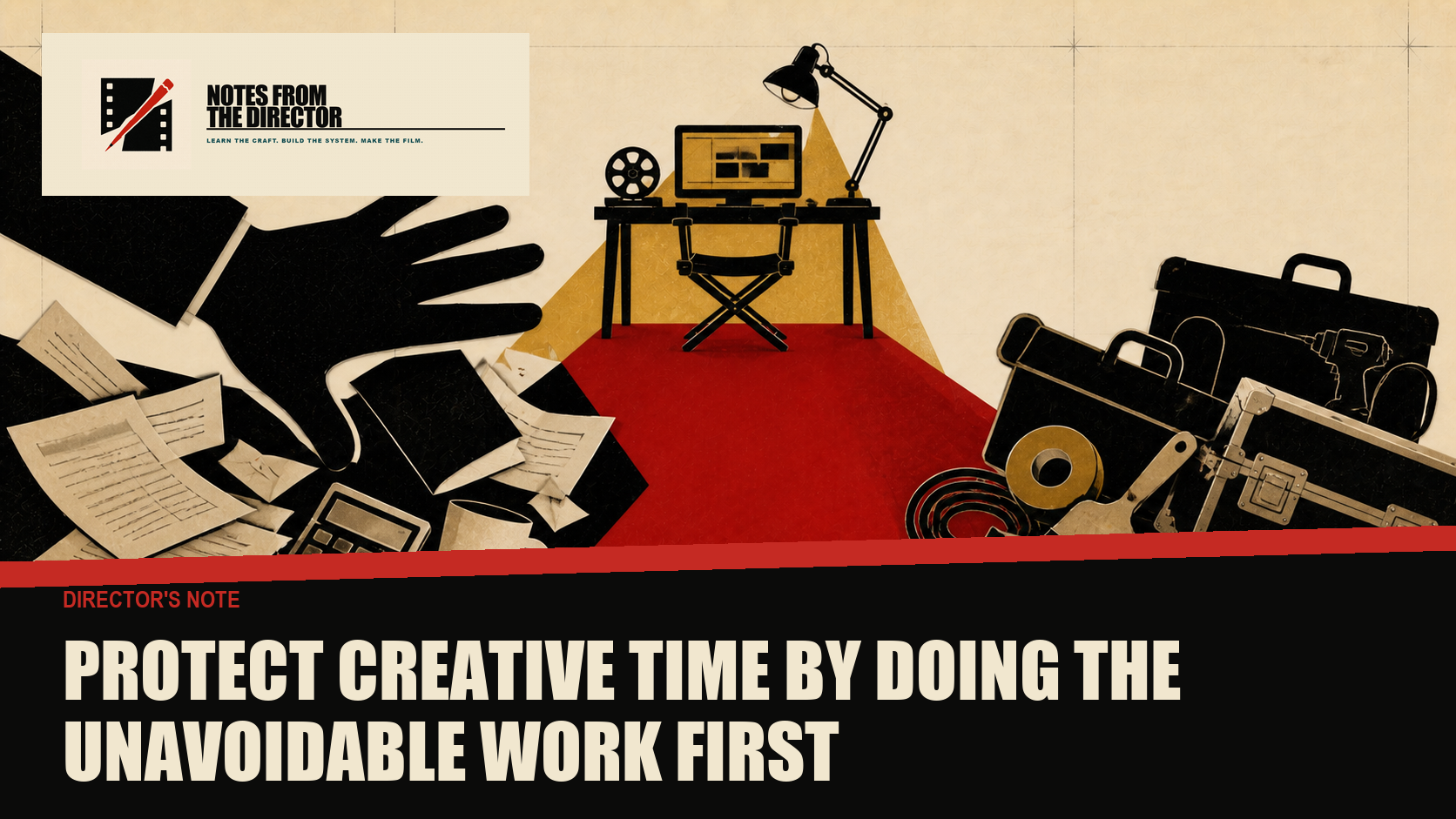
In the book, I describe doing the dreaded work first at the beginning of the week. The examples are ordinary: cleaning, bills, exercise, and the tasks you know must happen even though you would rather avoid them.
Completing those tasks creates relief. The rest of the week is not free from responsibility, but predictable obligations are less likely to invade the time set aside for creative work or family.
This is not a trick for becoming endlessly productive. It is a way to reduce avoidable friction.
What belongs in a weekly friction-clearing block?
Include tasks that are necessary, predictable, and capable of disrupting production if ignored.
Examples may include:
- Paying and recording bills
- Confirming appointments and production dates
- Cleaning or resetting the workspace
- Charging, checking, and returning equipment
- Handling required forms or messages
- Ordering essential supplies
- Scheduling exercise or health needs
- Resolving one decision another person is waiting on
Do not fill the block with every possible improvement to your life. It is not a general ambition session. It is a controlled pass through the obligations most likely to create noise or emergencies.
How long should the block be?
Start with one bounded session at the beginning of your workweek.
The book suggests Monday, or whatever day your week begins. The exact day matters less than the sequence. Clear the known friction before asking your mind to settle into deeper creative problems.
Choose a duration you can repeat. Ninety minutes of focused clearing may be more useful than declaring an entire day for life administration and then resenting the loss of production time.
If the list exceeds the block, rank tasks by consequence:
- What becomes more expensive if delayed?
- What blocks another person?
- What can interrupt a protected creative session?
- What affects health, safety, money, or access?
- What takes only a few minutes but closes a persistent loop?
Complete the highest-consequence items first.
Why not do creative work first instead?
Sometimes you should.
If your strongest creative hours are early and the obligations are genuinely contained, protect those hours. The principle is not that unpleasant work has moral priority. The principle is that known practical work needs a reliable place so it does not consume every other place.
Design the sequence around your actual energy and consequences.
You might use the first hour for writing, then a friction block, then return to production. You might clear the entire weekly list before beginning a long edit. You might divide required tasks into a daily twenty-minute opening.
The correct structure is the one that prevents obligations from becoming surprise producers on your project.
How do you keep the block from expanding forever?
Give each task a definition of done.
"Handle finances" is too vague. "Pay the four current bills and record confirmation numbers" can be completed. "Clean studio" can grow without limit. "Clear the desk, remove trash, and prepare tomorrow's equipment" has an end.
Use three boundaries:
- Time boundary: When the session starts and stops
- Task boundary: Which obligations are included this week
- Quality boundary: What condition closes each task
When the block ends, move unfinished low-consequence items to a later slot. Do not let administration take over the time it was meant to protect.
What is the weekly friction-clearing routine?
Run this routine before the production week gains speed.
- Empty the places where obligations collect.
- Identify tasks with real consequences this week.
- Mark anything that blocks another person.
- Complete the most dreaded necessary task.
- Close several small loops while the context is active.
- Prepare the materials required for the next creative milestone.
- Write the remaining obligations into specific later appointments.
- End by naming the next action on the creative project.
That final step matters. You want to leave the block facing the work you protected, not merely feeling relieved that the chores are over.
How does this support a creative career?
Creative work does not occur outside life. It occurs inside a system of health, money, relationships, maintenance, and commitments.
Ignoring that system does not make you more devoted to the art. It makes the art vulnerable to predictable disruption.
Handle the unavoidable work deliberately. Then use the room you created.
Open the script. Turn on the camera. Start the edit. Move the artifact one visible state closer to done before another week fills the space.
Next production note
Once immediate friction is cleared, you can inspect what your habits and environment reveal about the work you truly respect.
Continue to: Inventory What You Respect, Not What You Say You Love
Notes From the Director Learn the craft. Build the system. Make the film.
Source note
This article is adapted from No One Gives a F Until It's Done, PDF pages 25-26. Wayne's practice of handling dreaded weekly obligations before creative work provides the firsthand production principle.