The answer in brief
Constraints can improve a film's visual language when the limitation is translated into a consistent creative rule. The rule should reduce a repeated production burden while supporting the story's mood, clarity, or point of view. A limitation becomes style when the audience experiences an intentional world, not a sequence of compromises the team hopes nobody notices.
When does a limitation become a creative advantage?
Not every limitation is useful. Some simply remove options or create risk.
A limitation becomes creatively useful when it forces a clear decision that can be repeated across the film. The decision must protect both production capacity and the audience's experience.
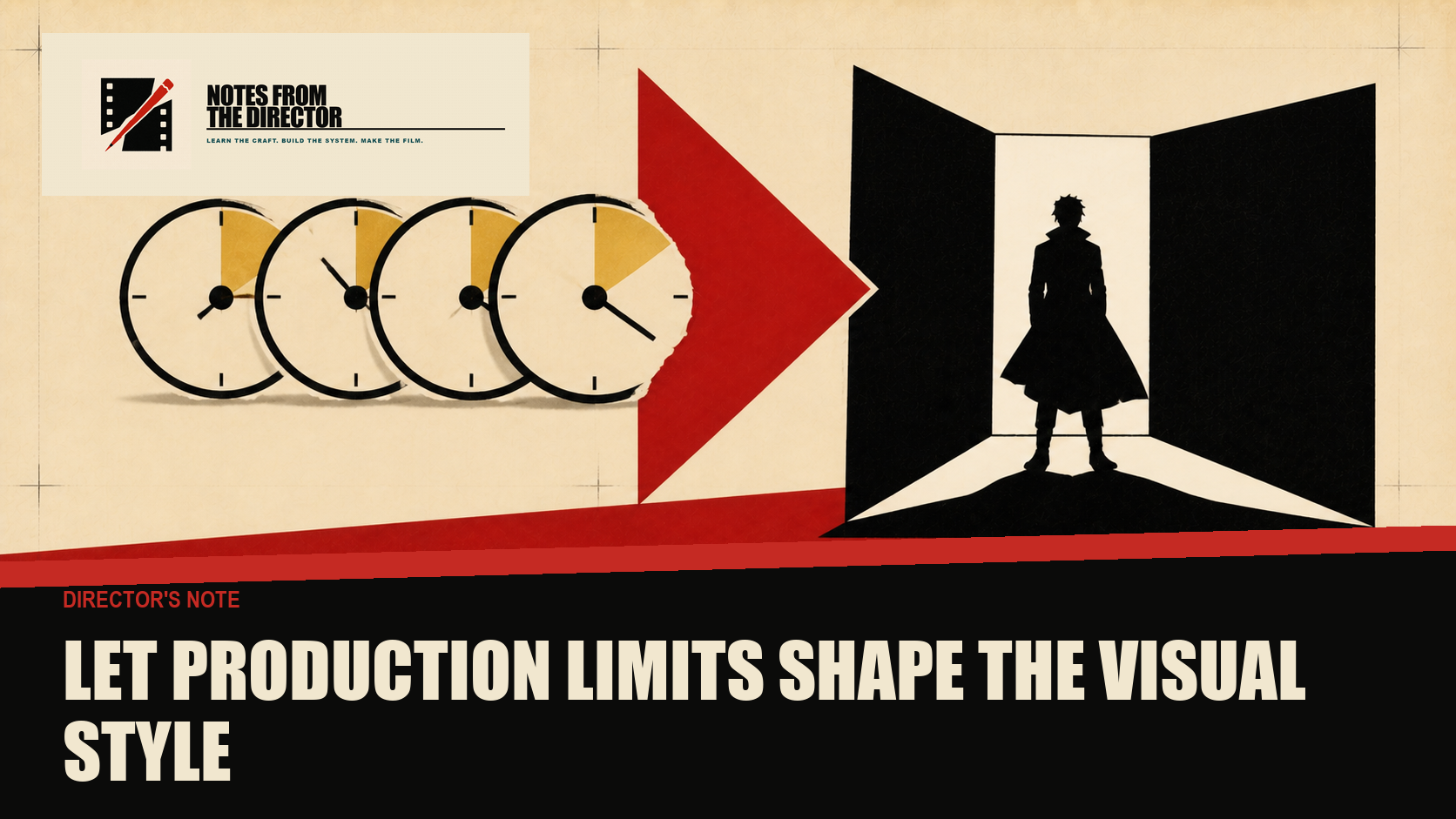
For Pod 4, our computing power could not support the kind of complex animated production that an earlier student project had attempted. One frame had taken a week or longer to render. That was not a small scheduling inconvenience. It made completion impossible at the intended scale.
We needed a visual rule that changed the math.
How did black and white solve more than one problem?
After the film was storyboarded, we designed characters and lighting around speed. The cartoon used a strict black-and-white approach. Even frames containing several characters rendered in about fifteen seconds.
The choice reduced technical demand, but it also gave the film a strong visual identity.
That combination matters. If a constraint only makes the work cheaper while weakening the story, the audience feels the absence. If it only makes the work beautiful while leaving the production impossible, the team still cannot finish.
The strongest constraint solves a capacity problem and creates a recognizable language at the same time.
Which production limits can shape style?
Look for a burden that appears in many shots. That is where one rule can produce a large effect.
- Limited render capacity can shape lighting, materials, detail, and movement.
- Limited locations can shape framing, blocking, time of day, and production design.
- Limited crew can shape camera movement and coverage strategy.
- Limited effects capacity can shape what happens on screen and what is implied through sound or reaction.
- Limited schedule can shape scene length, company moves, costume changes, and shot count.
- Limited asset capacity can shape silhouettes, repeated elements, and the number of unique designs.
Do not begin by asking how to hide the limit. Ask what visual rule could make the limit coherent.
How do you build a constraint-to-style matrix?
Write one row for each serious production limit. Then answer four questions.
- Limit: What cannot be produced reliably at the current scale?
- Repetition: Where does this burden multiply across the film?
- Story job: What must the audience feel or understand in those moments?
- Style rule: What consistent choice reduces the burden while serving that job?
For example, a film with limited set-building capacity might not scatter the story across many partial locations. It could commit to one controlled space and use composition, sound, entrances, and changing light to create progression.
The rule should be specific enough that another department can use it. "Keep it simple" is not a style rule. "Use one dominant silhouette and reveal the threat through sound before showing detail" is closer.
How do you test whether the rule can survive a film?
Build the hardest representative scene.
Do not test a quiet shot with one easy element if the film repeatedly requires groups, effects, movement, or complex lighting. Use the scene most likely to break the method.
Carry the test through the full pipeline. A design that is fast to create but slow to revise may not solve the real problem. A camera rule that reduces shooting time but leaves the edit without coverage may move the cost instead of reducing it.
Measure the result. Then ask whether the finished scene still feels intentional.
If it only looks limited, refine the rule. If it looks distinctive but remains too expensive, refine the process. Style and capacity must agree.
How do you keep the style from becoming a gimmick?
Connect every rule to the story.
The audience does not need to know about the computer lab, the render time, or the production spreadsheet. They need the visual world to feel appropriate to the film they are watching.
Write a sentence that joins form and meaning: "We use this visual rule because it allows the film to express this emotional condition within the capacity we can sustain."
If you can only finish the first half of that sentence, you have an efficiency choice. If you can only finish the second half, you may have an expensive mood board. Keep working until both parts are true.
What makes a constraint worth keeping on the next project?
After delivery, separate the rule from the emergency that created it.
Did the rule give the team faster decisions? Did it create consistency? Did it protect the schedule? Did the audience understand the intended mood? Did it create new storytelling options?
Some constraints should disappear when capacity grows. Others reveal the filmmaker's voice.
You do not need unlimited resources to create a deliberate visual language. You need an honest measure of the limit, a rule that serves the story, and the discipline to repeat it until the finished film feels whole.
Next production note
A coherent style reduces decisions. The next step is dividing the remaining work into units that people can own and complete.
Continue to: Divide Creative Work Into Units the Team Can Own
Notes From the Director Learn the craft. Build the system. Make the film.
Source note
This article is adapted from No One Gives a F Until It's Done, PDF pages 36-38. It draws on Wayne's account of designing Pod 4 in black and white so complex frames could render quickly enough for the small team to complete the film.