The answer in brief
Creative knowledge fails in production when it remains explanation instead of repeated decision-making. Theory can help you name principles, recognize options, and teach a method. Real work adds deadlines, clients, collaborators, revisions, and consequences. Until you have used the knowledge to finish an artifact, you do not know which parts you can actually control.
Why can correct knowledge still produce weak work?
Knowing what should happen and making it happen are different skills.
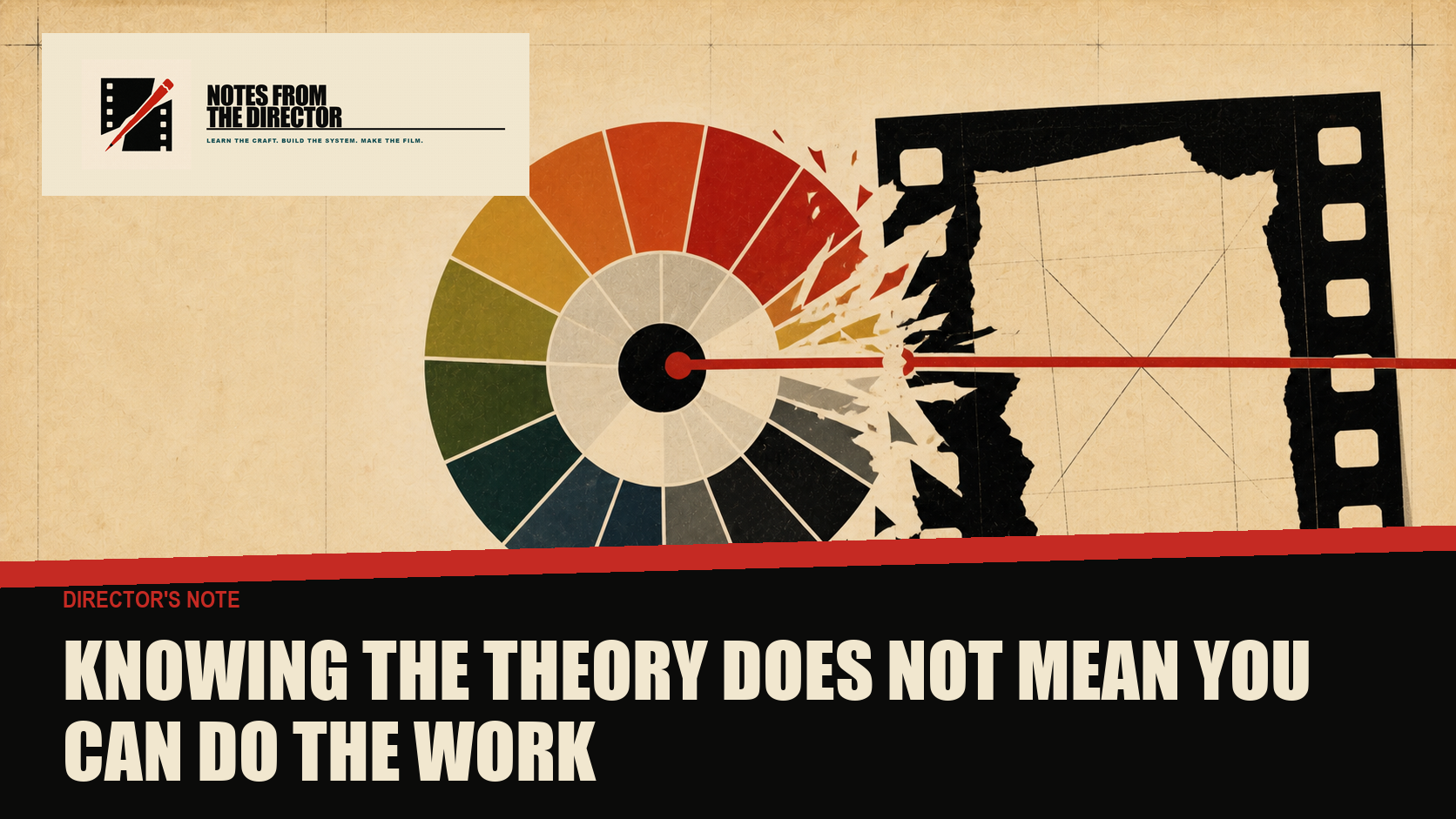
I have taught color theory for years. I can explain color relationships, contrast, temperature, harmony, and the way choices affect a composition. That knowledge is useful. It can give a creative person more deliberate control.
The difficult question comes afterward: So what?
In the manuscript, I tell the story of learning a precise, professional approach to color from an instructor named Scott. The method gave me a way to build combinations and moods rather than guess. I understood it well enough to teach it.
But explanation was not the same as finished application. When I stopped making designs, my practical ability did not grow simply because my vocabulary did.
What changes when knowledge meets a real production?
Production removes the clean edges around a lesson.
A principle must now operate inside a brief, schedule, medium, and approval process. The perfect palette may not survive the footage. The planned design may not reproduce correctly. A client may need a revision by morning. A collaborator may interpret the instruction differently than you expected.
Theory usually isolates one variable so it can be understood. Production asks that variable to cooperate with everything else.
That does not make theory useless. It reveals its job. Theory provides a map of possible choices. Craft is the ability to choose, execute, review, and adjust while moving the whole project toward completion.
What did my early failures expose?
Early teaching work gave me confidence and opened doors. I talked about my expertise. I took on a commercial, an apprenticeship, and other freelance work.
The results did not support the confidence.
I argued with a more experienced professional instead of listening. My work was weak and unfinished. A commercial I delivered was bad enough that I heard nothing after sending it. Other freelance jobs failed quickly. I could recite the theory and demonstrate the method, but I had not built the habit of producing strong finished work with it.
The problem was not that I knew too much. The problem was that I treated knowing as evidence that the work was already under control.
How do you find your own theory-to-practice gap?
Choose one skill you regularly claim, teach, or discuss. Then audit the last three finished projects in which that skill mattered.
- What principle did you intend to use?
- Where can another person see it in the final artifact?
- What decision became difficult under the deadline?
- Which part required revision after your first attempt?
- What feedback did the finished work receive?
- What can you now do faster or more reliably than before?
- Which part do you still explain better than you perform?
Do not answer with courses completed, books read, or software owned. Those are inputs. This audit is looking for applied evidence.
How do you convert theory into craft?
Build a short practice cycle around a real deliverable.
First, choose one principle. Do not try to demonstrate an entire discipline in one project.
Second, give the principle a visible job. If the lesson concerns color, decide what emotion, hierarchy, or story information the color must carry.
Third, work under a real constraint. Set a format, deadline, and acceptance condition.
Fourth, finish the artifact and show it to somebody who can respond to the result rather than your intention.
Fifth, document what changed between your explanation and the work. That gap is the next practice target.
Repeat until the principle becomes a decision you can make without hiding behind the terminology.
When is knowledge ready to become instruction?
You do not need to master an entire field before sharing what you know. You do need to be accurate about the level of your evidence.
You can say, "Here is the theory I am studying." You can say, "Here is how I used it on this project." You can say, "Here is where the result failed and what I changed next."
Those statements help learners because they separate the principle from the performance. They also keep the teacher inside the practice.
The dangerous sentence is, "I understand this, so I can already do it." Production has not signed that statement.
What proves the gap is closing?
The gap closes when your finished work becomes more deliberate, repeatable, and useful under constraint.
You should be able to point to a choice, explain why it served the project, and show that it survived delivery. The explanation matters. The artifact matters more.
Knowledge becomes craft one completed decision at a time.
Next production note
The next risk appears when early knowledge produces an expert identity before production has produced expert judgment.
Continue to: The Danger of Becoming the Expert Too Early
Notes From the Director Learn the craft. Build the system. Make the film.
Source note
This article is adapted from No One Gives a F Until It's Done, PDF pages 31-35. It uses Wayne's account of studying color, teaching it, and discovering through commercial and apprenticeship failures that explanation had exceeded practice.