The answer in brief
Partial production completions motivate a team when they are real, visible, and connected to the next work. An approved schedule, finished board sequence, built prop, or accepted scene does more than show activity. It reduces uncertainty and unlocks another department. Momentum grows when people can see that completed parts are becoming one finishable film.
Why does visible completion change the feeling of a project?
Long productions can feel imaginary for months. People work on pages, plans, designs, files, rehearsals, and tests while the finished film remains far away.
That distance makes effort difficult to judge. The team may be busy without knowing whether the project is becoming more possible.
Visible completion changes the question. Instead of asking whether progress is happening, people can point to an accepted artifact and see what it now allows.
The schedule is complete enough to assign days. The boards are complete enough to prepare the location. The prop is complete enough to rehearse. The rendered scene is complete enough to enter the edit.
Momentum is not excitement alone. It is reduced uncertainty moving through the pipeline.
How did the Breakables wall create momentum?
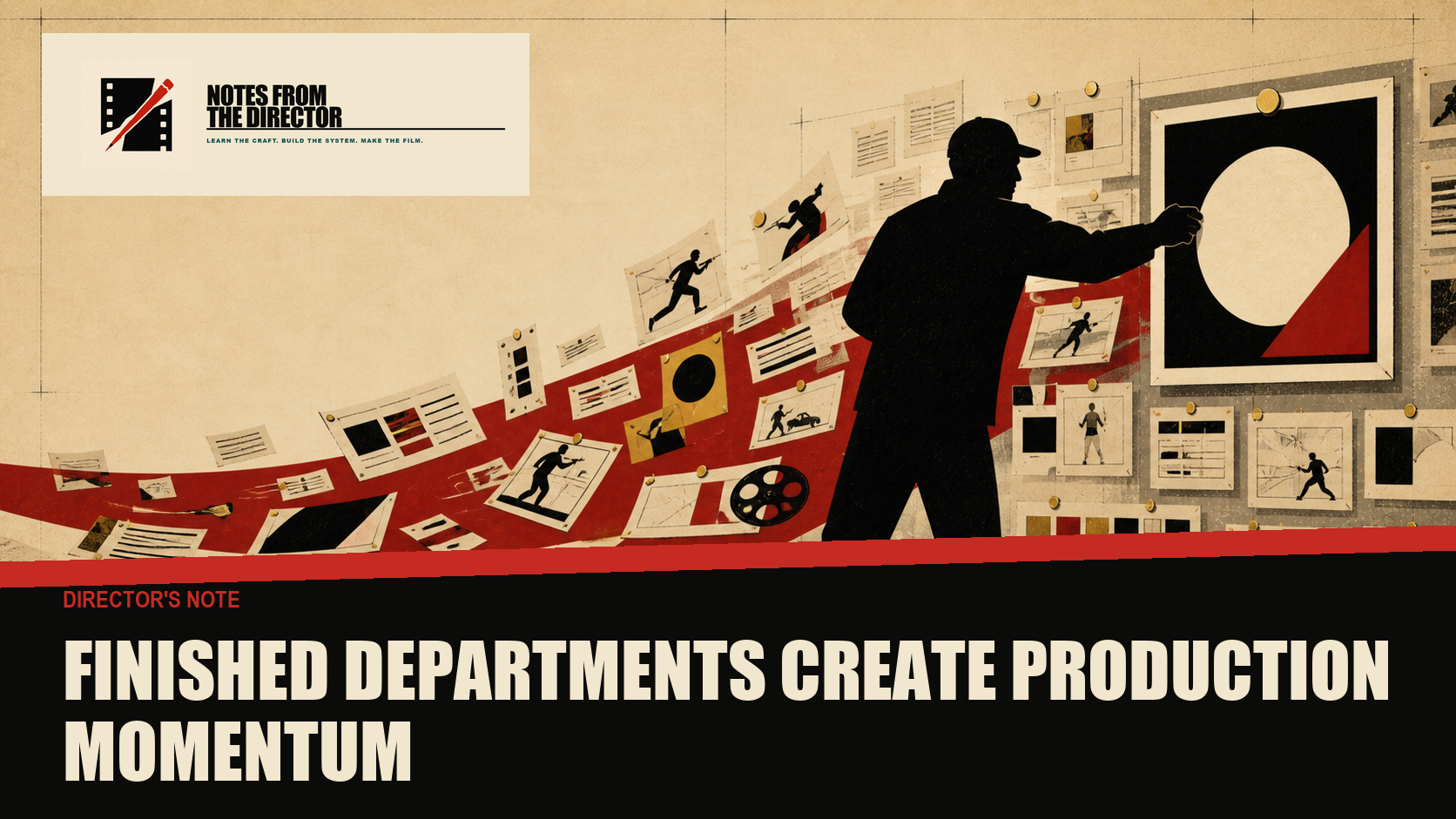
During Breakables, I covered a wall in my office with planning material. After the schedule, the storyboards developed scene by scene. As boards were completed, I hung them in the studio so the story could be seen linearly.
The wall allowed me to refine the story and compare it with the needs of locations, characters, and the schedule. It also gave collaborators visible evidence that the film was taking shape.
Students and friends became involved. We built sets, rehearsed, made props, and worked across different areas of production. Each completed part added to a larger picture the team could see.
The project stopped being a promise spoken by one person. It became a collection of finished work made by many people.
What kinds of completion create useful momentum?
The best milestone has a consequence beyond celebration.
- A locked scene intent allows boards and performance planning to proceed.
- A completed breakdown allows departments to identify their required work.
- An approved schedule allows people and locations to commit.
- A finished board sequence allows shots, props, and setups to be prepared.
- An accepted design allows construction or animation to begin.
- A completed scene allows editorial and sound to discover the next need.
- A verified delivery allows the production to close a promise.
Activity that cannot unlock or inform anything else may still be necessary, but it should not be mistaken for a major production milestone.
How do you build a department completion board?
Organize the board around accepted artifacts, not percentages.
For each department, show:
- the next artifact that must finish
- the person who owns it
- the condition required for acceptance
- the department or task it unlocks
- the current blocker
- the date the next decision is needed
Avoid a vague status such as "art department 80 percent complete." Eighty percent does not tell the camera team whether the hero prop is ready.
A specific statement does: "Hero prop approved and ready for rehearsal. Background dressing remains in progress."
The board should help people act, not merely reassure leadership.
Why does finishing one department inspire another?
Creative work contains uncertainty. People are often being asked to believe that dozens of unresolved pieces will eventually become coherent.
A finished artifact is local proof. It shows that the production can make decisions, solve problems, and accept work. That proof gives the next person a firmer place to begin.
In the manuscript, I describe how completing the schedule, budget, storyboards, and thousands of filmmaking steps built confidence and inspired the people around the project. We learned what we did not know while doing the craft.
The confidence was not a speech. It came from evidence accumulating on the wall and in the film.
How do you celebrate progress without declaring victory early?
Name exactly what finished and what it changed.
Say, "The boards for the opening are approved, so the location and camera teams can prepare from the same plan." Do not say, "We are almost there," unless the remaining work supports that claim.
Mark the contribution of the people who completed the unit. Then identify the next handoff while the context is clear.
This creates a rhythm:
- finish a defined artifact
- verify the acceptance condition
- show the result
- acknowledge the ownership
- unlock the next work
That rhythm protects morale because it joins recognition to forward motion.
What if the board shows no completions?
Do not add more motivational language. Find the blockage.
The units may be too large, the acceptance condition may be unclear, too many decisions may depend on one person, or the team may be starting work before inputs are approved.
Break the next deliverable into a smaller artifact that still creates value. Assign one owner. Set the review. Finish it. Then use the result to restart flow.
Momentum is built, not announced.
What does department completion finally serve?
Every board, schedule, prop, scene, sound cue, and approved decision exists to help the audience encounter one complete story.
Breakables eventually screened at a film festival. My favorite evidence of success was seeing a woman cry at the moment the story intended. The long chain of completed departments had reached a human consequence.
That is why partial completion matters. Each finished part carries the film closer to the person it was made for.
Next production note
The next department asks how much of that internal process the client needs to see, and which promises the process must protect before delivery.
CTA: Purchase No One Gives a F Until It's Done
Notes From the Director Learn the craft. Build the system. Make the film.
Source note
This article is adapted from No One Gives a F Until It's Done, PDF pages 40-41. It draws on Wayne's Breakables planning wall, completed storyboards, shared production work, and the film's later screening and intended audience response.