The answer in brief
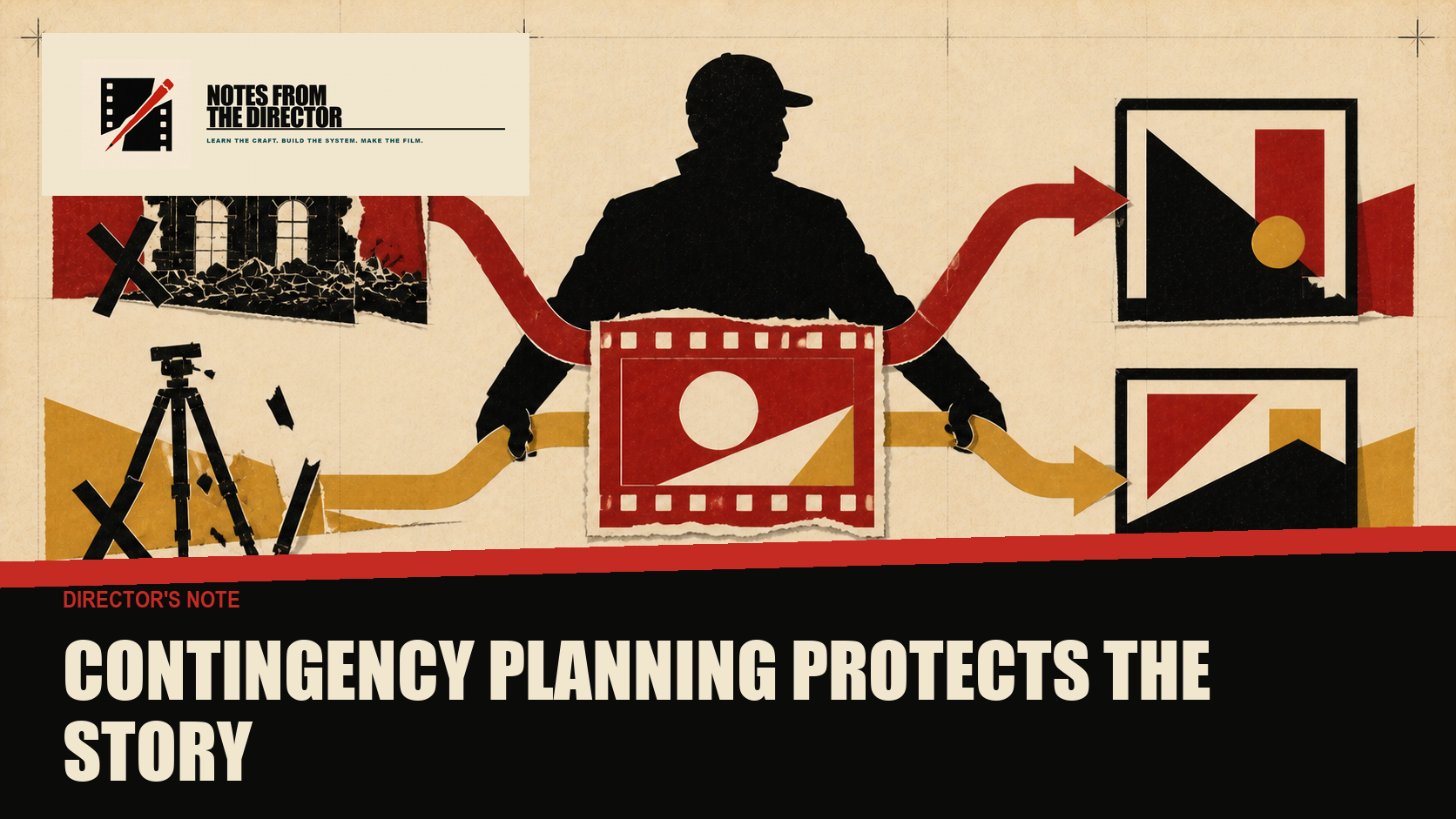
Filmmakers should plan contingencies around the few failures that could stop the production or destroy the scene's purpose. Identify each high-risk dependency, define an early warning sign, assign a decision owner, and prepare a fallback that preserves the essential story. A contingency turns panic into a choice the team has already considered.
Why do productions need a second path?
A film plan is built before reality has finished introducing itself.
The location may change. An effect may take longer. Equipment may fail. A performer may become unavailable. Weather, travel, approvals, or a late department delivery may remove an option the schedule depends on.
The answer is not to imagine every possible disaster. The answer is to recognize which parts of the plan carry the greatest consequence if they fail.
In the book, I describe the lesson I learned making Breakables: the schedule and budget have to work together, and the highest-risk parts need contingencies. That last piece matters because an otherwise organized production can still collapse around one unsupported dependency.
Does a backup plan weaken the creative idea?
Only if the team waits until the crisis to decide what the idea actually needs.
A good contingency begins with the scene's essential function. What must the audience understand, feel, or witness? Which element creates that effect? Which parts are preferred methods rather than the heart of the scene?
If the original location disappears, the answer may not be to find a weaker imitation overnight. The better answer may be to redesign the blocking around a controlled space that preserves the conflict. If an elaborate effect is not ready, the director may choose a practical fragment, sound, reaction, or offscreen consequence that carries the same story information.
That is not giving up. It is directing under real conditions.
Which risks deserve a contingency?
Start with dependencies that are both likely to fail and expensive to replace.
Review:
- single locations with no alternate access
- cast or crew available for only one narrow window
- untested effects or technical workflows
- equipment with no substitute
- scenes dependent on weather or exact light
- props, wardrobe, or builds with long replacement times
- approvals that can stop another department
- schedule days with no room for delay
- budget lines that cannot absorb overtime or repetition
Do not call every uncertainty a crisis. Rank the risks. The production needs attention concentrated where failure would spread.
What belongs in a risk and contingency register?
For each major risk, write:
- the dependency
- what failure would look like
- the earliest warning sign
- the final safe decision time
- the first-choice response
- the fallback response
- the effect on schedule and budget
- the person authorized to make the call
- the story element that must be protected
Keep the register short enough to use. A dense document ignored by the team is not protection.
When should the fallback be activated?
Set the trigger before the pressure arrives.
For example, do not say that the team will decide what to do if a build is late. State that if the build is not ready for a test by a specific time, the alternate version becomes the plan. Do not leave the crew waiting while leaders defend a possibility that has already become unrealistic.
The trigger protects the budget from wishful thinking. It also protects the people doing the work from a last-minute demand to recover time that leadership already lost.
How should a director judge a fallback?
Use three tests:
- Does it preserve the scene's essential story function?
- Can the current team execute it inside the remaining time and resources?
- Does choosing it now reduce greater damage later?
If the answer is yes, the fallback is viable even if it is not the version you first imagined.
The work is full of preferred versions. Finishing requires a version the production can actually carry.
What should happen during preproduction?
Walk through the riskiest day with the department leads. Ask each person what assumption they are depending on and what would make that assumption false.
Then decide:
- what can be tested now
- what must be confirmed in writing
- what can be simplified
- what alternative should be prepared
- who can approve the change
- when the original plan expires
This conversation often improves the first plan. A contingency exposes the hidden structure of the scene and forces the director to decide what truly matters.
Production tells the truth. The contingency is how you make sure that truth does not erase the story.
Next production note
Continue to: Automate the Repetition, Not the Judgment
Notes From the Director
Learn the craft. Build the system. Make the film.
Source note
This article is adapted from "No One Gives a F Until It's Done," PDF page 43. It develops Wayne's manuscript principle that schedules and budgets need contingencies for the parts of a production carrying the highest risk.