The answer in brief
Finish VFX with limited rendering capacity by counting the remaining shots, measuring real processing time, standardizing the workflow, prioritizing dependencies, and building a verified queue with recovery capacity. Do not wait for final approval to discover that the machines cannot finish the work. The delivery plan must include the infrastructure that turns approved shots into final files.
Why is the final mile a separate production problem?
Creating the shot is not the same as delivering it.
A sequence may be designed, animated, composited, and approved but still require rendering, stereoscopic processing, color work, quality control, revisions, storage, and final assembly. Each step has a throughput limit.
During Shockwave Darkside, the remaining work included hundreds of complex point-of-view shots, display graphics, digital environments, and changes to the landscape. The film also required stereoscopic work and a complete color grade.
The creative workload was only part of the problem. We had to determine how the finished material would actually be processed.
What does limited capacity look like?
It looks like approved work waiting behind a machine, a person, or a process that cannot move fast enough.
The bottleneck may be rendering, but it can also be file transfer, storage, review, color, conform, or quality control. If the team produces shots faster than the bottleneck can complete them, the queue grows until the deadline becomes impossible.
Hope does not increase throughput.
Measure one representative unit from start to verified finish. Then multiply it across the real remaining count, including expected failures and revisions.
What did the production build?
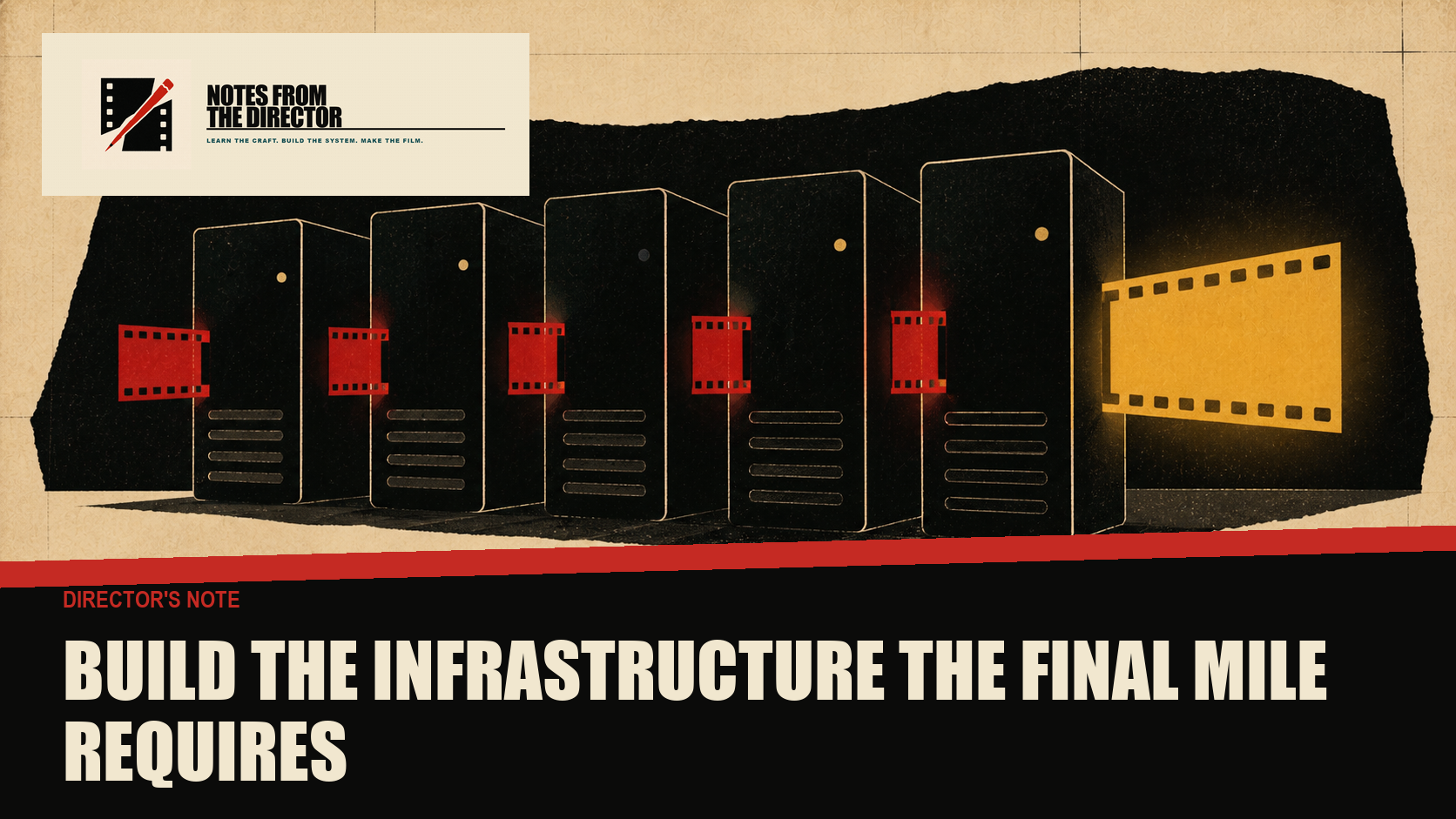
One of the final things my father helped me do was install the electrical capacity needed in my garage so I could set up a render farm.
That detail matters because the plan required more than additional computers. The infrastructure had to support the machines safely and consistently. The shots needed somewhere to run while the team continued solving the creative and technical work.
The final result was carried through a physical system built for the demand.
What belongs in a final-mile capacity plan?
Start with the actual remaining inventory:
- shots awaiting work
- shots awaiting approval
- shots ready to render
- average processing time by shot type
- available machines and operating hours
- storage and transfer requirements
- likely failure and rerender rate
- people required for review and quality control
- delivery formats and due dates
- time reserved for final corrections
Separate creative completion from technical completion. A shot is not delivered merely because the artist is finished with it.
How should the queue be prioritized?
Do not simply render in the order work arrives.
Prioritize:
- shots required to validate the pipeline
- shots that unlock editorial or color decisions
- high-risk shots likely to fail
- sequences needed for an early review
- long renders that can run while other work continues
- final shots with stable approval
Avoid filling the queue with material likely to change. A render farm can waste a night as efficiently as it can save one.
Why does standardization matter?
The production also standardized repeatable parts of the work, including the process for the three-dimensional display graphics. Adam handled hundreds of shadows needed across the film, and I used a dominant color treatment that helped unify the grade.
Standardization reduced the number of decisions that had to be reinvented shot by shot. It gave the team a controlled way to move through volume.
That does not mean every shot became identical. It means the shared technical problem received a shared solution.
What should be verified before the final push?
Run one complete representative shot through the whole pipeline.
Confirm:
- source files are current
- naming and version rules are correct
- the render settings match delivery
- both eyes or required variants align
- color is consistent
- outputs open and play correctly
- storage can hold the remaining work
- failed jobs are detected
- the team knows how to restart safely
- final review can keep pace with output
The test should end with a file that could actually ship.
What is the leadership lesson?
Infrastructure is part of the creative promise.
If the story depends on hundreds of effects, the production must build a path for hundreds of effects to become files. If the budget cannot buy unlimited capacity, scope, standardization, priority, and time must carry more of the load.
The final mile is not where the team becomes heroic. It is where the production proves whether its system can complete what its imagination started.
Next production note
Continue to: Finish Without Pretending the Cost Was Noble
Notes From the Director
Learn the craft. Build the system. Make the film.
Source note
This article is adapted from "No One Gives a F Until It's Done," PDF pages 55-56. It uses Wayne's account of building a garage render farm, standardizing repeated VFX work, and completing the remaining Shockwave Darkside shots under limited resources.