The answer in brief
Filmmakers should automate work that is repetitive, rules-based, high-volume, and easy to verify. Keep people responsible for interpretation, creative choices, exceptions, and approval. The goal is not to remove judgment from production. It is to stop spending skilled human hours rebuilding the same predictable object when a reliable system can assemble it.
What problem should automation solve?
Automation should begin with a real production bottleneck, not with excitement about a tool.
While managing the design department on Twelve Forever, I was responsible for the flow of model sheets across characters, sets, props, and effects. An average episode involved hundreds of individual sheets, and the full production involved thousands before revisions.
Creating every sheet and entering the required information by hand could consume hours. I had heard how project managers on another production stayed up night after night to complete the same kind of work. There were three of them. On this production, the responsibility was mine.
The repeated assembly was the bottleneck. The creative decisions were not.
What did the system automate?
I built a template-driven workflow using the production data already organized in spreadsheets. A plug-in carried that approved information into presentation files and generated the model sheets.
Hundreds of sheets could be assembled in seconds. The team still had to get the breakdown right. Artists still had to draw the work. The art still required review and approval.
The automation removed the repeated document construction. It did not decide which model belonged in the episode, what the character should look like, or whether a drawing was ready.
That boundary is the lesson.
Which production tasks are good candidates?
Look for tasks with stable inputs and predictable outputs:
- generating consistent documents from approved data
- applying filenames and version conventions
- creating folders and repeated project structures
- transferring status fields between controlled records
- assembling review lists from current production data
- checking for missing required fields
- exporting repeated deliverable variants with fixed settings
- notifying an owner when a defined condition is met
Each example still needs verification. Automation can reproduce an error faster than a person can.
Which work should remain human?
Keep human ownership where the work depends on context, taste, consequence, or an exception the rules cannot safely resolve.
That includes:
- interpreting what the story needs
- choosing between competing creative approaches
- evaluating performance and emotional clarity
- deciding whether a limitation improves or damages the work
- approving a final image, edit, design, or delivery
- responding to a new risk that changes the plan
- deciding what should not be made
A system can prepare the decision. It should not hide the fact that a decision exists.
What is the automation suitability test?
Before automating a task, answer:
- Is the task repeated often enough to justify a system?
- Are the inputs structured and controlled?
- Can the expected output be described clearly?
- Can errors be detected before they reach the next department?
- Is there an owner for exceptions?
- Is final approval still visible?
- Will the system save more time than it costs to maintain?
- Can the team operate if the automation fails?
If the task changes every time or depends on subtle creative judgment, automation may create more confusion than capacity.
Run the task manually with the rules visible before automating it. The team should understand the sequence, the required inputs, and the acceptable result. A tool cannot repair a process whose owners disagree about what the work is supposed to produce.
How do you protect quality?
Build a checkpoint after the automated step.
Compare a sample against the approved source. Confirm naming, required fields, page structure, and count. Flag missing or conflicting data instead of guessing. Make the current version obvious. Keep a manual recovery path for the deadline that cannot wait for a repair.
Most importantly, improve the source data. My template worked because the team still had to make the breakdown accurate. If the breakdown was wrong, the generated sheets would be wrong with impressive speed.
What is the real return?
The return is not simply fewer clicks. It is recovered attention.
When hundreds of hours of document assembly became a much smaller task, the team could spend its effort on the work only people could do. The system made the production more deliverable without pretending that creativity had become automatic.
Ask where your team is repeatedly copying, naming, formatting, sorting, or rebuilding the same structure. Then protect the judgment and remove the repetition around it.
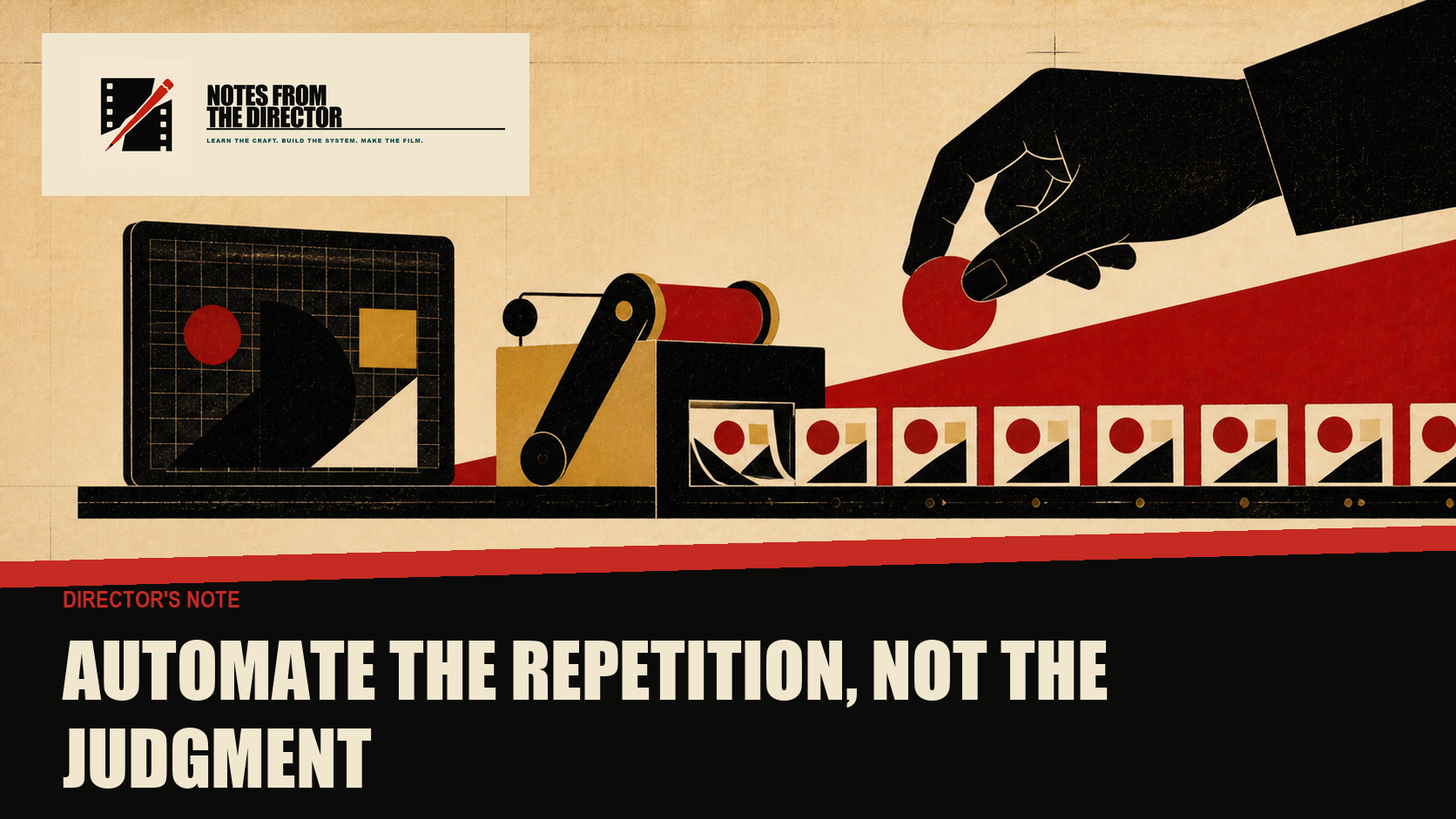
The machine should carry the boxes. People should decide what belongs inside them.
Next production note
Continue to: Templates Are Production Infrastructure
Notes From the Director
Learn the craft. Build the system. Make the film.
Source note
This article is adapted from "No One Gives a F Until It's Done," PDF pages 44-45. It uses Wayne's firsthand account of templating the model-sheet workflow for the design department on Twelve Forever.