The answer in brief
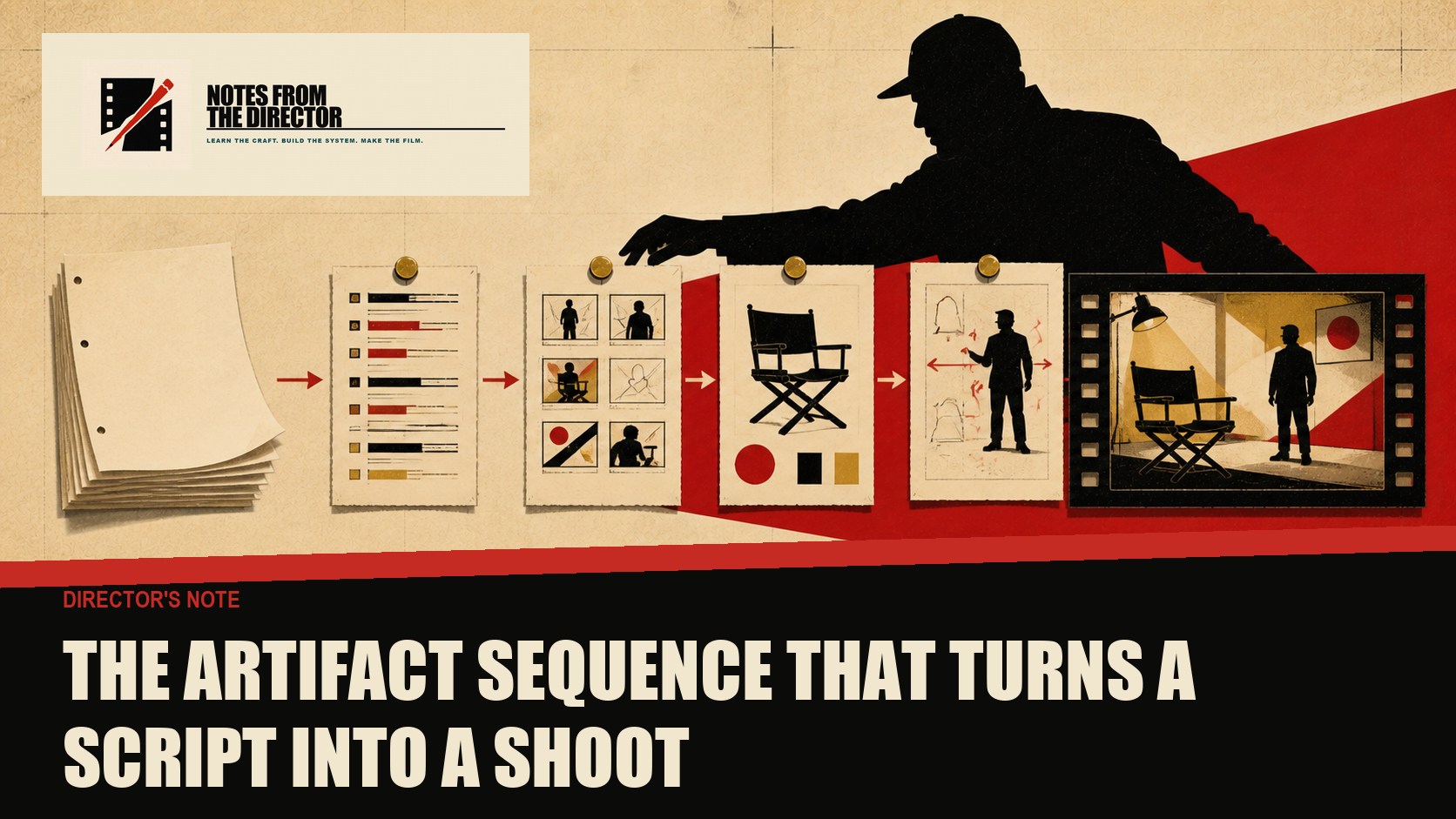
A director should create production documents in a sequence that turns story intention into assignable work: script breakdowns, resource lists, schedule and budget, storyboards or shot plans, department-specific build lists, rehearsal decisions, and current approval records. The exact tools can vary. Each artifact should answer a new production question and hand usable information to the next department.
Why is the script not enough?
The script describes the experience the film intends to create. Production needs to know what must exist, who must be present, where the work happens, and when every dependency can be assembled.
Those questions are distributed across departments. The art team looks for sets and props. Wardrobe looks for character changes. The schedule looks for cast, locations, time, and company moves. The camera team looks for coverage and equipment. The budget looks for the cost created by all of it.
If that information remains buried in prose, every department performs its own private interpretation. Gaps appear on the shooting day, when they are most expensive.
Production artifacts make the interpretation visible early enough to correct it.
What did Breakables teach me about preparation?
I began Breakables while teaching film budgeting and scheduling because I wanted to understand how those disciplines affected a real production. I wanted to make another feature without repeating a five-year path.
The project became a laboratory for organizing the work.
I filled an office wall with dry-erase planning sheets. The schedule was not a calendar alone. It grew from breakdowns for props, characters, locations, effects, extras, vehicles, costumes, cast, crew, and equipment. Those elements connected story decisions to time and money.
Once the schedule took shape, I moved into storyboarding. Each artifact exposed information needed by the next one.
What is the useful sequence?
The sequence should move from story meaning toward production commitment.
- Script and scene intent: What changes, and what must the audience understand?
- Breakdown: Which people, places, objects, effects, and conditions does each scene require?
- Resource and risk review: What exists, what must be secured, and what is fragile?
- Schedule and budget: In what order can the work happen, and what does that order cost?
- Storyboards or shot plan: How will the required story information become images and sound?
- Department lists: What must be designed, built, purchased, rehearsed, or tested?
- Approval record: Which version and decisions are current?
- Shooting plan: What exact work must the day complete?
This is not a rigid software workflow. It is a chain of decisions. If one artifact changes, identify which later artifacts now contain stale information.
How do boards improve more than camera planning?
For Breakables, I used a 3D storyboarding program that allowed sets, characters, and cameras to be arranged. Collaborators created custom elements so the boards resembled the intended film.
As scenes were completed, I placed them on the studio wall. Seeing the story linearly allowed me to refine the film while comparing it with the schedule, locations, and characters.
That made the boards a production interface. They connected story, camera, schedule, design, and team communication.
A useful board does not need to be beautiful. It needs to make a decision visible. What is the shot doing? What must be in it? Which department depends on the answer?
How do you prevent document production from becoming busywork?
Every artifact must have a user and a decision.
Before creating one, answer:
- Who will use this?
- What question will it answer?
- What must be approved before it becomes current?
- Which downstream task will it unlock?
- How will a change be communicated?
If nobody uses the document to prepare, choose, approve, or hand off work, it may be decoration.
The goal is not to fill binders. The goal is to keep important decisions from living only in somebody's memory.
What belongs in the artifact-chain checklist?
Before the first shooting day, confirm that the chain is connected.
- Every scene has a clear story purpose.
- Every scene has been broken into required production elements.
- Cast, crew, locations, equipment, props, wardrobe, effects, and special conditions have owners.
- The schedule reflects real dependencies and location logic.
- The budget reflects the schedule actually being proposed.
- Boards or shot plans cover the story information editorial will need.
- Rehearsals or tests have resolved the highest-risk assumptions.
- Each department knows the current version and acceptance condition.
- Changes can be traced into the affected schedule, budget, and lists.
The checklist does not guarantee a painless shoot. It gives the production a common picture of what it is attempting.
How does the sequence protect the creative idea?
Planning is sometimes treated as the work that happens after the important creative choices. It is where those choices become survivable.
A breakdown reveals the cost of a story decision. A board reveals whether the visual plan expresses the scene. A schedule reveals whether the right elements can meet on the same day. A rehearsal reveals whether the performance and blocking support the intended turn.
Each artifact asks the idea to become more specific. That pressure can improve the film before the camera records the mistake.
The script starts the promise. The artifact sequence builds the production capable of keeping it.
Next production note
As these departments complete their pieces, the visible evidence of progress can pull a team toward the next finish.
Continue to: Finished Departments Create Production Momentum
Notes From the Director Learn the craft. Build the system. Make the film.
Source note
This article is adapted from No One Gives a F Until It's Done, PDF pages 39-41. It uses Wayne's account of developing Breakables through breakdowns, a wall-sized schedule, 3D storyboards, custom board assets, sets, rehearsals, and props.