The answer in brief
Promising creative businesses fail during execution when demand arrives before ownership, money, production, and delivery are connected. A strong concept and early interest cannot compensate for a broken handoff. Before promoting the offer, map one complete order-to-delivery path, assign every step, and test it with a real transaction.
Why is a good idea not enough for a business?
A good idea can attract attention before the operation behind it is ready.
That is dangerous because attention feels like proof that the business works. People respond to an advertisement. A distributor agrees to supply products. A friend says they will place an order. The team starts talking about scale.
None of those events completes the customer's journey.
In the book, I describe an early plan my friends and I formed around our unfinished science fiction role-playing game. We wanted to raise money, hire a writer and illustrator, publish the game, and support the effort through an online game shop.
The concept had real signals. A distributor explained how we could become a reseller. We arranged a national advertisement. An artist completed the ad. Friends from my Army years were prepared to become customers.
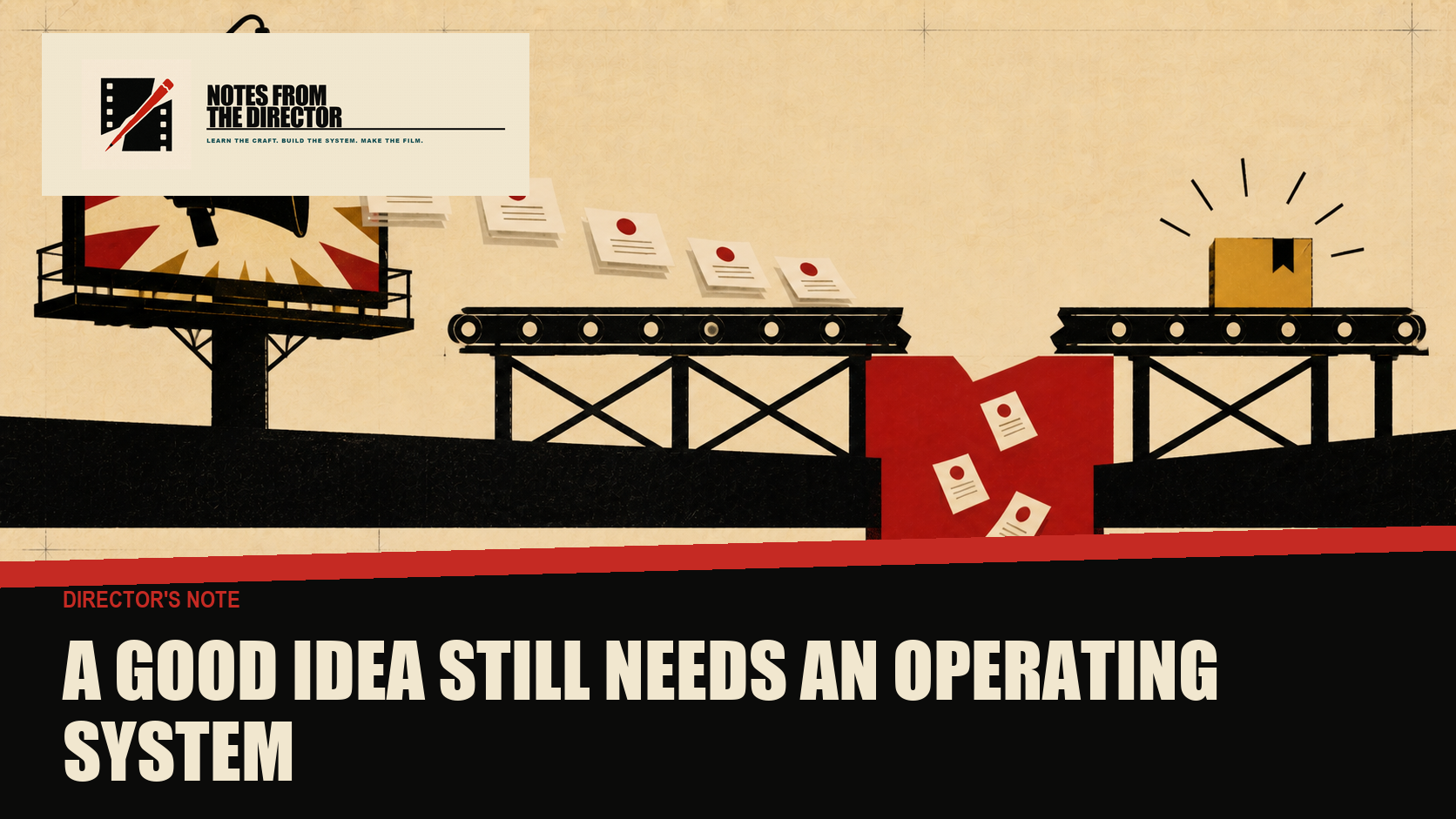
Then an order arrived, and the operation could not reliably retrieve, purchase, pack, and ship it.
The gap between interest and delivery told the truth.
What is a creative operating system?
It is the visible path that carries a promise through people and work until the customer receives the result.
For a small creative business, that path might begin with an inquiry and end with approved files. For a shop, it begins with a product request and ends when the correct item reaches the buyer. For a production company, it may run from script approval through scheduling, production, post, review, and final delivery.
The operating system includes more than the creative act. It includes the parts creators often postpone:
- How requests enter
- Who confirms scope and price
- Where money is received and recorded
- Who owns each production step
- How the current version is identified
- What happens when a dependency fails
- How the finished result is checked
- How delivery is confirmed
If one of those steps exists only in someone's memory, it is fragile.
Where did our handoffs break?
Our plan depended on a printed catalog, a website, a shared bank account, access to a post office box, wholesale purchasing, and manual fulfillment.
The catalog depended on someone connected to the group through a personal relationship. The website depended on that person's brother. When the relationship ended, both workstreams stopped. Conflict inside the group grew. Money was taken from the joint account. The first known order sat beyond my access.
No single document or owner held the complete path.
The lesson is not to avoid collaborators. The lesson is to make responsibility, access, and fallback visible before outside people trust the promise.
How do you map order to delivery?
Choose one normal customer request. Write every state it must pass through without skipping the boring parts.
- Request received
- Scope or product confirmed
- Price accepted
- Payment received
- Materials or inventory secured
- Work assigned
- Work completed
- Quality checked
- Delivery prepared
- Customer receives it
- Receipt or approval recorded
For every state, name one owner, one record, and one exit condition.
The owner is the person accountable for movement. The record is where anyone authorized can see the state. The exit condition is the fact that allows the work to move forward.
If two people assume the other owns a step, the step is unowned. If access belongs to one unavailable person, the step is blocked. If nobody can tell whether a condition has been met, the step is uncontrolled.
What should happen before you advertise?
Run the system with one real or controlled transaction.
Do not merely click through the attractive parts. Use the actual payment method, actual account access, actual production files, actual packaging, and actual delivery destination. Let a person who did not design the process attempt to follow it.
Record every point where they need an explanation or permission not written into the system. Those are not small inconveniences. They are places where demand can become disappointment.
Correct the path, then repeat the test.
Promotion should increase the load on a working system. It should not be the event that discovers whether a system exists.
What is the minimum operating-system audit?
Before the next public offer, verify these conditions:
- One person owns the complete customer journey.
- Every critical account has deliberate, appropriate access.
- Money can be received, identified, and reconciled.
- The team knows which version, item, or deliverable is current.
- Each handoff has a visible acceptance condition.
- A failed collaborator or tool has a fallback path.
- One full transaction has reached confirmed delivery.
- The customer can get a clear answer when something goes wrong.
A creative business is not finished when the idea attracts an order. It is working when the promise survives every handoff and reaches the person who trusted it.
Next production note
Once the operating path exists, the creator still has to let real people see the work before confidence feels complete.
Continue to: Publish the Work Before You Feel Fully Ready
Notes From the Director Learn the craft. Build the system. Make the film.
Source note
This article is adapted from No One Gives a F Until It's Done, PDF pages 15-18. Wayne's early reseller, catalog, website, advertising, order, and team experience is presented as the firsthand operating lesson.